

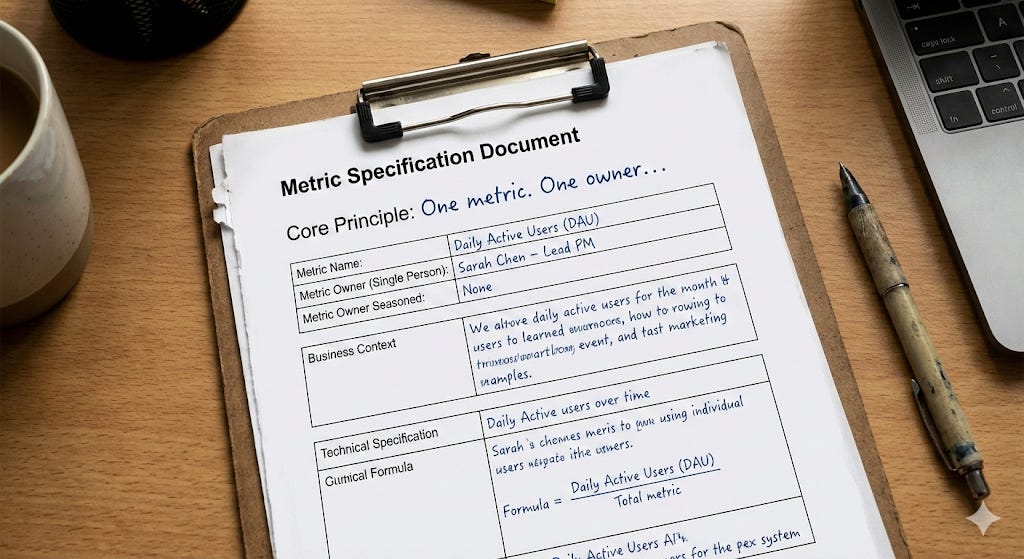
Metric Specification Template
One metric. One owner. Clear accountability.
Most metric problems don’t start with bad data.
They start with missing ownership.
I’ve never seen a metric that was widely used, business-critical, and still healthy without one clear owner behind it.
This template exists to fix that.
What this is
This is a Metric Specification Template I use to make metrics hold once they start being used across teams, dashboards, reports, and AI models.
It’s not documentation for the sake of documentation.
It’s a working contract.
The goal is simple: make it explicit who owns the metric, what it means, how it’s calculated, and when it’s allowed to change.
When to use it
Use this template when:
A metric is used by multiple teams
Different dashboards show different numbers
People argue about definitions instead of decisions
Data quality issues keep coming back
No one can confidently answer “who owns this?”
If a metric matters enough to be discussed, it matters enough to be owned.
The real problem it addresses
Most organisations already have:
Pipelines
Dashboards
BI tools
What they don’t have is:
A single accountable owner
Clear decision authority
Explicit change rules
Without those, every “data quality issue” becomes a recurring incident instead of a solvable problem.
This template forces the hard conversations to happen before something breaks.
How to use it in practice
This works best when you:
Fill it out with the business owner present
Name one accountable owner, not a team
Treat disagreement as a signal, not a blocker
Publish it somewhere visible
Refer back to it when the metric is challenged
If it’s never referenced again, it wasn’t done properly.
Document, not spreadsheet
I use this as a document, not a spreadsheet.
The purpose is to slow things down enough to get clarity on:
Meaning
Ownership
Accountability
Once the definition is stable, you can always operationalise it in a registry or sheet later.
The template
You can copy and use the full Metric Specification Template here:
👉 https://metric-specification-tem-nk2q3lz.gamma.site/
It’s structured to force decisions, not box-ticking.
Common misuse (what to avoid)
Treating this as admin work
Assigning ownership to “the team”
Filling in formulas but skipping purpose
Allowing silent changes “just this once”
If ownership is vague, everything downstream will be too.
Why this matters even more now
As analytics and AI scale, metrics stop being passive.
They start driving forecasts, automation, and decisions.
That makes unclear ownership a risk, not just an inconvenience.
Clean pipelines won’t save you from unclear accountability.
Start here
If you’re serious about improving data quality, trust in numbers, or AI readiness, start by fixing metric ownership.
This template is the simplest place to begin.
More tools will follow.
We are finally working on this where I work. Data Governance is huge (:
Thank's for an excellent KPI template...
...looking forward to more of your content!
It's unusual to find something that are simple and understandably.
Specially loved the separation of what & why from the how!